

Living, Witnessing, Belonging
Tal Leder
Israel
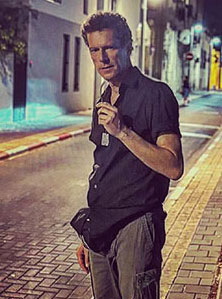
Born and raised in Nürnberg and Frankfurt, I moved to Tel Aviv nearly twenty years ago, where my whole family also lives, and where my wife Laurence and I made our home in Jaffa. Israel is not simply the place where I work; it is where my life, memories, and responsibilities are rooted. Since October 7, 2023, my connection to this country has changed profoundly, it has deepened and gained new clarity.
I experienced October 7, 2023, in Tel Aviv, a day that has come to be remembered as “Black Shabbat”. Even far from the border of Gaza, the day was shattering: the sirens, the uncertainty, the sudden realization that something fundamental had been torn open. Tel Aviv, the first Hebrew City—a place I love for its energy, beaches, contradictions, and stubborn joy—felt exposed and fragile. And yet, it also revealed its strength. Only days later, as a journalist, I traveled south to bear witnesses. The destroyed kibbutzim, the silence, the smell of devastation dismantled any remaining professional distance. This was not a story unfolding elsewhere. This was home.
For years, as a journalist and licensed tour guide, I have explained Israel’s history, landscapes, and complexities to readers and travelers alike. Places like Masada, overlooking the endless desert, have always symbolized resilience, survival, and the price of freedom. Since October 7, that symbolism has shifted. It is no longer simply history; it is a reminder that endurance is woven into this land and its people.

Israel is not just a state or a concept, it is
people showing up for one another.

During two years of intense fighting, I reported from war zones in Israel’s south and in Gaza. I visited communities along the Lebanese border, battered by Hezbollah attacks, towns emptied of everyday life. Everywhere, I encountered the same quiet determination: courage in the face of fear.
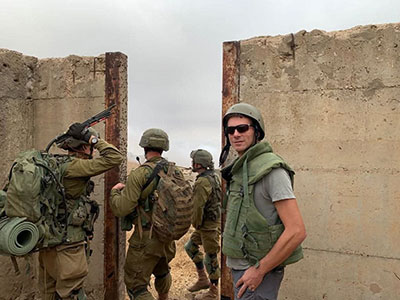 Like all Israelis, my family and I have lived with war as a daily reality. We learned to adapt, to endure uncertainty, to hold on to normalcy wherever possible. During this time, I did more than report. I delivered supplies to soldiers, cooked for them on their bases, and even led guided tours during the most difficult periods. My wife and I spent long hours in bomb shelters during rocket attacks by Iran’s proxies and by the Iranian regime itself. These experiences reshaped my understanding of belonging. Israel is not just a state or a concept, it is people showing up for one another.
As the prophet Jeremiah writes in Jeremiah 31:3, "I have loved you with an everlasting love; I have drawn you with unfailing kindness." These words feel painfully relevant today. To love Israel is to love its people—in all their diversity, disagreements, and contradictions.
Like in the time of the twelve tribes, Israel is a mosaic of many voices and identities. Across lineages, traditions and political movements: we are all part of this story. Since October 7, I no longer observe this country from the outside. It is part of who I am. To love it now means staying, helping, questioning, and continuing to tell its story. Israel is not just my home. It is part of my responsibility.
When Pain has a Name
Karen Kanan Roffe
Mexico
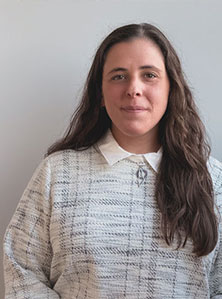 We belong to a generation marked by a specific inheritance: we are grandchildren, great-grandchildren, and great-great-grandchildren of survivors of historical persecutions. The suffering of previous generations not only transmitted extreme resilience; it also shaped the inner ways we hold and process trauma.
October 7 unleashed an immense and undeniable pain, both in Israel and throughout the Jewish diaspora. From that day onward, horror became impossible to fully process: war, destruction, conscripted and fallen soldiers, an unceasing accumulation of testimonies and stories alongside the denial of facts, the persecution of Jews outside Israel, and an unprecedented global resurgence of antisemitism. Each atrocity is too much for the mind to process.
That is why, within the collective horror, particular stories emerge—stories that feel intimately familiar.
Amid all the chaos, what activated the deepest pain in my own story was the knowledge that 251 people had been taken hostage: People my age and my husband’s; my sisters’, my nephews’, my cousins’, my friends’. They took grandparents, fathers, mothers, children, and grandchildren. Two hundred and fifty-one people like me. Two hundred and fifty-one people like everyone.
Among all those suspended lives, there was one story that became impossible for me to let go of, it was the story of Arbel Yehoud. At first, consuming suffering at a distance through news and social media was overwhelming. It was like a succession of abstract horror that left me paralyzed. Approaching her family and allowing myself to become emotionally invested was far more painful than remaining a distant observer would have been, but it was also transformative. For the first time, my pain had significant direction, words, and meaning.
What connected me to Arbel wasn’t anything heroic, it was deeply human. We shared ordinary points of life: a fascination with space, the central place our nephews hold in our lives, and the way friends become family. Ordinary, universal things we likely share with many others. But it was these small coincidences that reminded me each day that she could have been me, and that I could have been her. The glimpses of life her family shared on social media, which at first I watched from a distance, continually brought me back to the humanity we shared.
The closer I drew, the more my pain grew; and the more my pain grew, the stronger my need to act became. It was pain itself that pushed me to do more: helplessness, desperation, the constant contact with something profoundly uncomfortable. Behind it were countless therapy sessions, tears, sleepless nights, existential crises, extreme fear, and emotions that were deeply complex to manage. All of this coexisted with a difficult truth: I was in Mexico, safe, with my family unharmed, and yet I was falling apart.
It is no accident that Jewish communities and movements around the world awakened in this moment.
To inhabit that space of distance, safety, and real pain forced me to confront a responsibility that I couldn’t ignore anymore. It made me ask myself: what do I do with this privilege, while others have none? Understanding this made me realize that my pain was real, even though I wasn’t exposed to the same loss and risk. Arbel didn’t have a voice, and at that moment, I decided to try to let mine be hers.
Today, after 482 days in captivity, Arbel is back. So is the love of her life, Ariel Cunio, who was taken alongside her and held captive separately for 738 days. And finally, after 843 days, the struggle for the hostages ended when the last body, that of Ran Gvili, was recovered from Gaza.
October 7 and the days that followed marked an existential rupture in me that completely reshaped my understanding of pain, belonging, and ethical responsibility. It is no accident that Jewish communities and movements around the world awakened in this moment. There is something in our heritage and our collective DNA, in the transgenerational memory of our people, that that does not allow us to remain still or silent in the face of persecution or indifference in the face of trauma.
I know I am one among thousands who found in a specific story a way to bear what would otherwise have been impossible to grasp. The helplessness of being far away is heavy. Being one among thousands does not dilute responsibility, it sharpens it. There was a part of me that understood that if I didn’t do something concrete with this pain, the trauma would remain unbound, without form, without direction. Not without pain, but without destination.
After all this time, I am still the same person, and I am still carrying the experience and the pain of this experience. I know that Arbel, Ariel, and their family face a long and complex recovery. The question now is no longer how to endure horror from a distance, but rather, what piece is mine to move so that the pain of those who survived can find a voice and a path toward meaning? What can I do so that a life that was violently interrupted can feel, even minimally, liveable again?
Through this journey of pain, connection, and action, my love for Israel has deepened in ways I could never have anticipated. It is not only a place of history or homeland, but a living community that calls for engagement, connection, and collective responsibility. My heart is intertwined with its people, its struggles, and its resilience, and that connection shapes how I live, respond, and bear witness today.
Carrying Forward a Love for Israel
Elizabeth Cohen
Israel Bonds, France
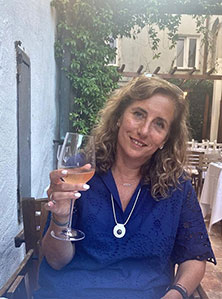 Some places stay with us quietly, long before we find the right words to explain why. Israel has always been one of those places for me. Long before it became part of my professional life, it was part of my family story.
My father was deeply involved in the Jewish community of Fez, in Morocco. Helping Moroccan Jews make aliya to Israel was something he believed in strongly, and he did so with discretion and conviction. Growing up, I didn’t always realize how much that quiet commitment would shape my own connection to Israel. Today, I understand it as a legacy of responsibility, love, and continuity.
For more than twenty years, I built my career as a lawyer, a path that made my father proud. But since October 7th, something has shifted. Working for Israel Bonds during such a difficult and meaningful period has been a true privilege. I felt genuinely useful at a time when many were searching for concrete ways to support Israel.
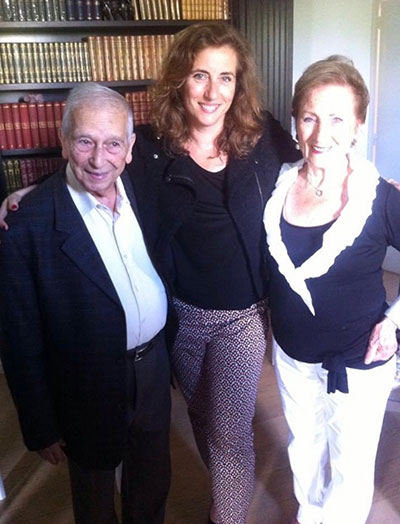
Elizabeth (center) with her parents
What touched me deeply was also experiencing the love and solidarity coming from France. Again and again, I saw how naturally that attachment to Israel translated into action. Those moments reminded me that connection to Israel is not abstract, it is lived, shared, and passed on.
I often think that while my father was proud of my legal career, he would be even more proud today. Through my work with Israel Bonds, I feel that I am contributing, in my own way, to Israel’s strength and future, guided by the values he passed on to me.
Israel is not only part of my work. It is part of who I am. And more than ever, it lives in my heart.
Love That Bears Responsibility
Joe Ozer
Israel Bonds Executive Director, UK
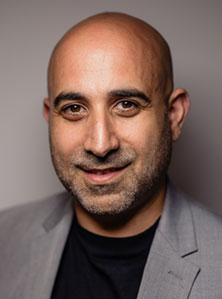 2023 was a huge year for us in the Ozer household. In August, the birth of our first daughter was, as it is for everyone, a truly transformative moment. All of a sudden, a little human relies on you to be their entire world. Keeping them safe becomes everything, and your sense of responsibility shifts overnight.
Then October 7th happened. And as a new father, you realise that this hits differently.
Every few years, Israel experiences flare-ups of tension and, worse, military operations. Each time brings a familiar feeling of dread and sadness about what’s unfolding there. Sadly, this has long felt like part of the course for our families and friends in Israel. But this time, as a new dad, I found myself thinking differently about that “course” and why it suddenly felt so much heavier.
How would I one day explain to my daughter that these things happen to us because we were born into a religion, an ethnicity? How would I explain that the country so often under attack is also potentially our safe haven, should we ever need one? I’m not ashamed to say it felt profoundly different this time.
And if October 7th wasn’t bad enough, October 8th and everything that followed felt even worse. The phrases we in Jewish communities around the world have heard weekly since then; the posters we’ve seen daily, ripped and defaced; the videos of commentators and leaders dodging the hard questions about why October 7th was unequivocally wrong — all of it created a whirlwind of emotion and, unexpectedly, a deeper personal appreciation for the State of Israel.
While my friends and I sat around discussing where we could, in theory, up sticks and leave to, my family in Israel — living under barrages of rockets — were only concerned about our wellbeing, thousands of miles away. That Israeli spirit, that resilience and tenacity, is what built Israel, and what continues to make it a country of strangers who are, in truth, all family.
Photo by Blake Ezra Photography
Our Bond with Israel is Stronger Than Ever
Eyla Benedykt
Brazil Representative
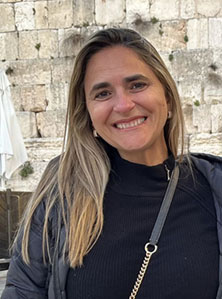 Since October 7th, the world has taken on a different meaning for us as Jews. From that moment on, we witnessed an alarming rise in antisemitism in Brazil and across many parts of the world. We realized that even in a country known for diversity and peaceful coexistence, like Brazil, prejudice had been dormant and suddenly reawakened in a troubling way. Acts of hatred, misinformation, and intolerance became more frequent, revealing a reality many believed had been left behind.
These events showed us, painfully, how vulnerable our identity can become outside of Israel. In times of crisis, we are reminded that our sense of safety and belonging can be fragile. It was in this context that Israel became even more clearly our homeland, our historical and spiritual home, and, above all, our safe harbor. More than a country, Israel represents the continuity of our people, our strength, and our hope.
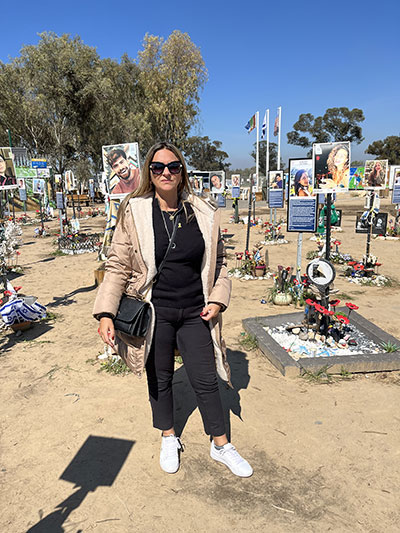 During this difficult period, I had the opportunity to be in Israel in the midst of the war. I visited the site of the Nova Festival and the areas attacked by Hamas. Seeing everything up close was deeply moving and heartbreaking. Walking through those places, hearing the stories, and feeling the weight of so many lives cut short was an experience I will never forget. So many families were shattered, so many dreams were lost, and so much pain was left behind.
Every step carried silence, memory, and respect. It was impossible not to reflect on each person who had been there celebrating life, only to have their story taken away. That visit strengthened my understanding of the value of life, unity, and our responsibility toward one another.
At the same time, in the midst of so much sorrow, I witnessed something truly beautiful: the strength of our community. I saw children, youth, adults, and seniors united by a shared purpose, to support Israel and to support one another. Through gatherings, events, campaigns, prayers, and acts of solidarity, we showed that we are a resilient people, capable of transforming suffering into unity.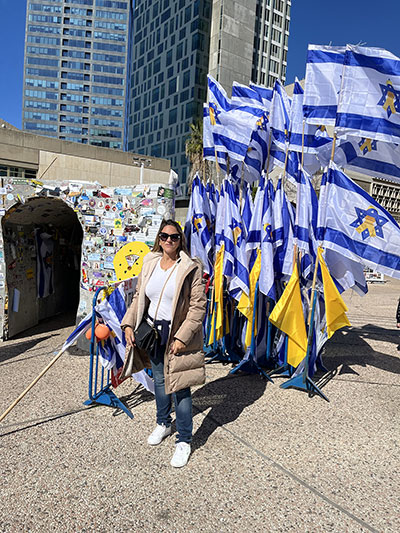
It was moving to realize that no matter where we live, we remain deeply connected. Even spread across the world, we share one history, deep-rooted values, and an unwavering commitment to our future. Every message, every gesture of support reaffirmed that we are not alone.
We also experienced a deeply emotional moment with the return of the body of the last hostage to Israel. Even in the midst of pain, it brought a sense of closure, dignity, and remembrance. Finally, we were able to remove the yellow ribbon that had accompanied us since October 7, 2023, a silent symbol of waiting, suffering, and faith. It reminded us that we never leave anyone behind and that every life matters.
Today, my connection to Israel is stronger than ever. I carry this bond with pride, responsibility, and love. We will continue to stand united, strong, committed, and determined, fighting for Israel, for our identity, and for our future. Because our strength lies in our unity, our memory, and the hope that lives on through generations.